Remarks
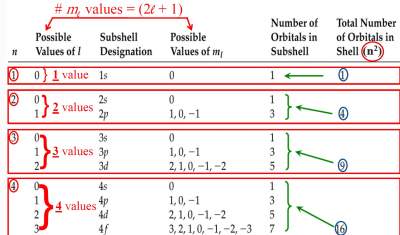
- The shell with a principal quantum number (n) consists of exactly n subshells. (Example: n = 3 has 3 subshells (s, p, d))
- Each subshell consists of a specific number of orbitals, each corresponds to a different allowed value of ml. (Example: p subshell has 3 orbitals with ml values of +1, 0 and -1)
- For a given value of l, there are (2l +1) allowed values of ml , ranging from −l to +l.
Example: l = 2 (d subshell) has 2 × 2 + 1 = 5 orbitals with 5 values of ml +2, +1, 0, − 1, − 2)
- The total number of orbitals in a shell that has a principal quantum number (n) is (n2).(Example: n = 3 has 9 orbitals total)
Example
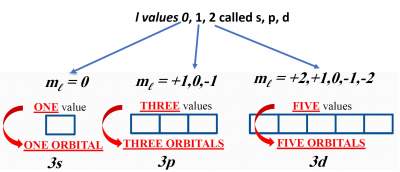
In the third shell: n =3 is the shell number → 3 sub-shells with l values 0, 1, 2 called s, p, d → 3s, sp, sd see illustrated below:
Exercise
Exercise on Finding the Designated Shell
Check your answers here:
Solution to the Exercise on Finding the Designated Shell
Example: l = 2 (d subshell) has 2 × 2 + 1 = 5 orbitals with 5 values of ml +2, +1, 0, − 1, − 2)