Introduction
"The best arrangement of a given number of electron domainsis the one that minimizes the repulsions among them".
Principles:
- Electrons adopt an arrangement in space to minimize e−e repulsion.
- When considering the geometry about the central atom, all electrons (bonding and non-bonding pairs) are considered.
- When naming the molecular geometry, we focus only onthe positions of the atoms.
According to the VSEPR theory, Geometry of a molecule is determined based on the number of electron domains around the central atom of a molecule, called Electron-Domain Geometry.
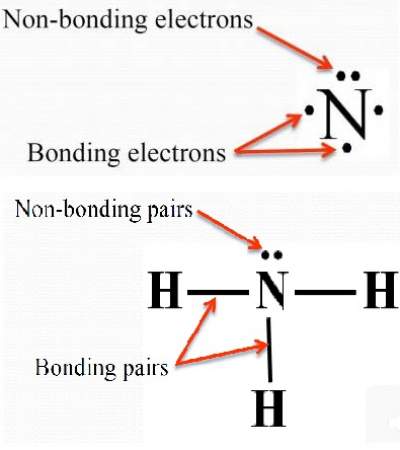
Types of Electron Domains
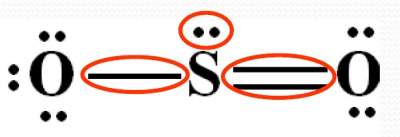
Example SO2
As shown below, the central atom (S) has three (3) electron domains: (one nonbonding pair, one single bond & one double bond)
Electron-Domain Geometries
How can an electron-domain geometry be determined?
Steps:
- Draw the Lewis structure.
- Count the total number of electron pairs (domains)around the central atom.
- Arrange the electron pairs (domains) in one of the five (5)geometries to minimize e−e repulsion.
Example: NH3 Molecule
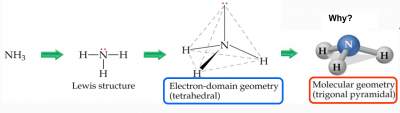
What is the difference between:
- Electron-domain geometry
- Molecular geometry
This is attributed to the difference between bonding and non-bonding electrons
Electron-Domain Geometry: depends on the number of electron domains around the central atom.
Molecular Geometry: depends on the type of electron domains around the central atom; so that non-bonding pairs will no be extended in space.
The effect of difference in type of electron domain on bond angle:
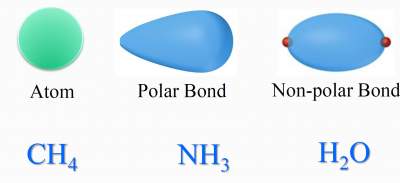
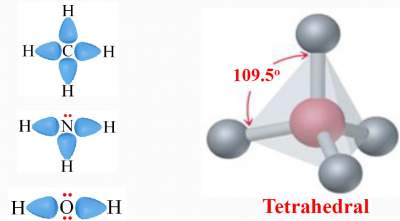
Based on the # of electron domains around each of the central atoms, these molecules should adopt the tetrahedral
geometry with a typical angle of 109.5° .
Non-bonding electrons
Non-bonding electrons affect the bond angle in molecules containing them.
Example:CH4, NH3 and H2O, all have the same electron-domain geometry; tetrahedral with different bond angles.
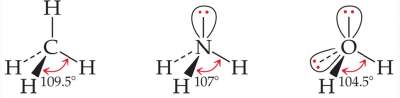
This is attributed to the repulsion between the high electron density in the non-bonding pairs and the close bonding pairs.
This results in different molecular geometries of these molecules.
Multiple Bonds
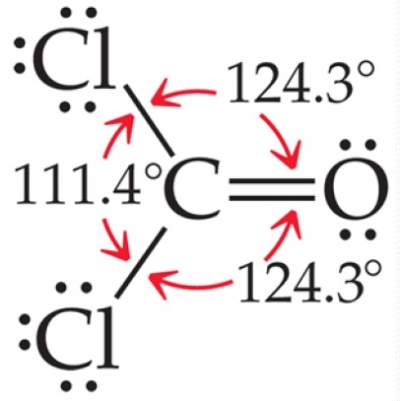
Multiple Bonds also affect bond angles in molecules containing them.
Example:Cl2CO molecule
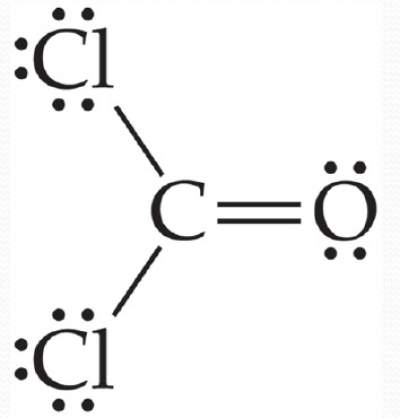
The central atom is surrounded by 3 bonding electron domains, hence both the electron-domain and molecular geometries should be:
Trigonal Planarwith a bond angle of 120°
But, due to repulsion between the high electron density of the double bonds and the surrounding bonding electrons,
bond angles are distorted to minimize this repulsion.
Remark
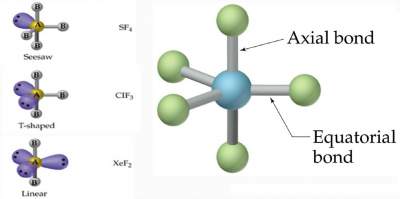
In case the number of electron domains around the central atom is five (5), where the electron domain geometry is trigonalbipyramidal,
nonbonding pairs are always placed in the equatorial plane to minimize repulsion.
Exercisess on The VSEPR Model:
Exercise I on The VSEPR Model
Check your answers here:
Solution to the Exercise I on The VSEPR Model
Exercise II on The VSEPR Model: Shape of Larger Molecules
Check your answers here:
Solution to the Exercise II on The VSEPR Model: Shape of Larger Molecules
Exercise III on The VSEPR Model: Shape of Larger Molecules
Check your answers here:
Solution to the Exercise III on The VSEPR Model: Shape of Larger Molecules
Exercise IV on The VSEPR Model: Shape of Larger Molecules
Check your answers here:
Solution to the Exercise IV on The VSEPR Model: Shape of Larger Molecules
Exercise V Ion The VSEPR Model: Shape of Larger Molecules
Check your answers here:
Solution to the Exercise V on The VSEPR Model: Shape of Larger Molecules
Exercise VI Ion The VSEPR Model: Shape of Larger Molecules
Check your answers here:
Solution to the Exercise VI on The VSEPR Model: Shape of Larger Molecules
For more details, please contact me here.
Date of last modification: 2024