Representation of Orbitals
Representation of Orbitals of Single-Electron Atoms
There are four types of sub-shells (sub-levels); s, p, d, f, which contain the orbitals
→ Shape of the
- the s− orbital
- the p− orbital
- the d− orbital
the f− orbital
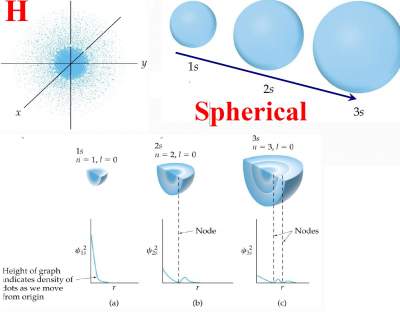
The s − orbital
- The lowest energy orbital
- The size of the orbital increases with n
- The probability decreases to zero as r (from the nucleus) increases
The p − orbital
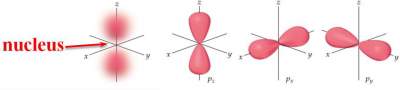
- Electron density is concentrated on 2 regions on either sides of the nucleus, separated by a node at the nucleus.
- The final picture is a dumbbell shape orbital with 2 lobes.
- For the same value of (n), orbitals have the same size and shape, but different spatial orientation.
- Size of the p orbitals increases with (n), i.e. 2p < 3p < 4p
The d − orbital
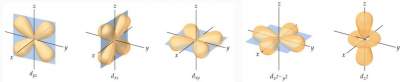
- There are 5-d orbitals with the same energy, although they look different in shape.
- The size of the d orbitals increases as (n) increases.
Many-electron Atoms
The atomic orbitals in a many-electron atom are like those of the H atom, but energetically different.
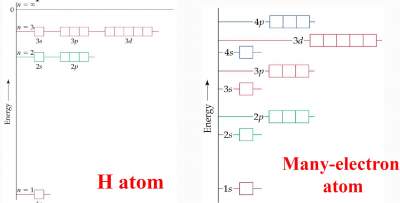
For a given value of (n), the energy of the orbital increases with the value of l:
s < p < d
For the same value of (l ), orbitals have the same energy. These orbitals are thus called: degenerate
Electron Spin
The electron behaves as if it were a tiny sphere spinning on its own axis.
Hence, Spin Magnetic Quantum Number (ms), where ms indicates the 2 opposite directions of spinning:
+½ and − ½
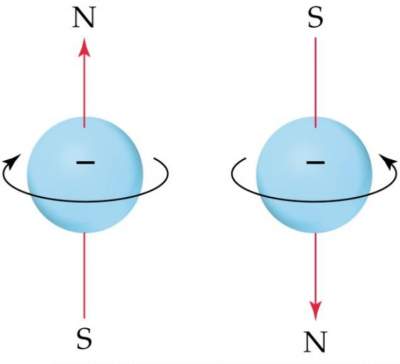
Note: ms is called spin magnetic because a spinning charge produces a magnetic field
For more details, please contact me here.
Date of last modification: 2024